YR 47 Issue 1 2011
Faces
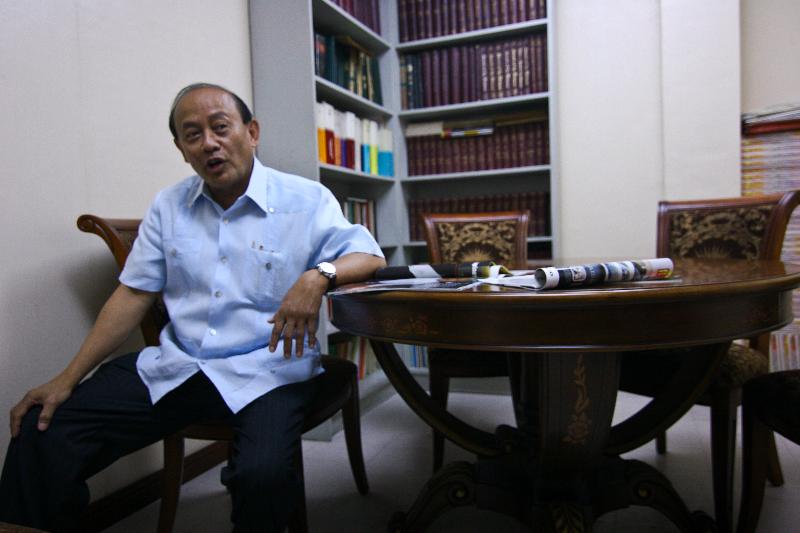
Antonio “Tony” Lopez
Unfazed journalist in the midst of martial rule
Unfazed journalist in the midst of martial rule
By RANDOLPH B. LEONGSON and KATHLEEN T. DE VILLA
The declaration of Martial Law brought the country to an era filled with terror. Violation of human rights, abduction of opposition members, and muzzling of the fourth estate became rampant in the society. While some chose to remain silent, others courageously demanded for change and fought for the restoration of democracy.
WHILE everyone else was fearful and restless during the Martial Law regime, Arts and Letters alumnus and veteran journalist Antonio “Tony” Lopez bravely held accounts of one of the biggest political upheaval experienced by the country that endangered and haunted his day-to-day life.
Brought by the courage and persistence he possessed in his journalistic endeavors, he was able to uncover the sordid realities during the term of the late president Ferdinand Marcos.
Embarking into dangerous stints in the pursuit of his career made him become one of the country’s most distinguished journalists who took risks and rose from the ranks during the Marcos administration.
Twist of fate
As a professional journalist for 41 years, Lopez started mastering his own craft when he was still in high school.
Even if he planned to become a lawyer, fate had other plans for him as studying in college only became possible when he acquired a four-year journalism scholarship from the Lacson Foundation.
While he was still studying, he was the managing editor of The Varsitarian, the official student publication of UST, and in 1970, he graduated magna cum laude, major in Journalism.
Upon graduation, he joined various newspaper outfits in the country such as the Manila Chronicle, The Manila Times, and The Times Journal.
“Journalism is a passion; otherwise, you merely do it as a work. In fact, it is one of the few professions granted by the constitution,” he said referring to Article III, Section 4 of the 1987 Philippine Constitution that states the right of citizens to speak freely.
Lopez said that his passion for journalism is the natural consequence of his interest in reading and writing. Aside from this, he noted that having a scientific mind helped him in his journalistic endeavors.
“A scientific mind is unfazed by failures and is persistent and curious,” Lopez said. “A scientific mind does not accept things as they are unless they are proven. Verity begins first as a theory,” he said.
His philosophies have largely helped him in his career when everyone else, including the print and broadcast media, were censored and muzzled by the government, except those who were classified as cronies and loyalists of the Marcos administration.
He noted that journalists were naturally victims of Martial Law due to the danger involved and the number of rules imposed against them during that period. This made it hard for reporters to uncover the real story behind the status of the country.
“During that time, anyone can die just because of a stray bullet,” he said, noting the great danger that emanated in the country during the period.
“I actually lost my job in the Manila Times,” Lopez said. “I came to the office one day and a colleague said to me, ‘walang press press dito!”
Bold and unfazed
Lopez is recognized as one of the notable journalists who objectively reported incidents during the Marcos administration. Armed with his audacity and persistence, he dared to ask probing questions during press conferences and interviews with President Marcos.
He also took bold moves in making his stories. He did not mind the dangers brought by his actions because for him, it is the journalist’s job to uncover what has to be revealed regardless how life threatening it may be.
He recounted the instance in October 1972, barely a month after Martial Law was declared, when he pretended to be an investigator just to see and to take pictures of the remains of a Japanese straggler killed
by the military in Lubang, Mindoro.
“I went to the National Bureau of Investigation morgue to view the remains of the victim This was about 10 p.m., two hours before the curfew imposed by the government,” Lopez said.
He also shared the threats he faced after interviewing the mother of Rolando Galman’s girlfriend a week after Benigno “Ninoy” Aquino, Jr.’s assassination. Galman was the alleged gunman who shot Aquino at the tarmac of the Manila International Airport (now Ninoy Aquino International Airport).
“She [Galman’s girlfriend] was kidnapped and killed. After the interview I had with her mother, a car trailed me up to my house. For several days, I was being trailed,” he said.
Tales of martial rule
Upon learning about the withdrawal from position of then Defense Secretary Juan Ponce Enrile and former Armed Forces Vice Chief of Staff Fidel Ramos, Lopez went straight to Manila coming from the coverage of the rally led by the late president Corazon Aquino in Cebu.
Lopez said that his stay at Camp Aguinaldo and later at Camp Crame for the 1986 People Power Revolution from February 22 to 25 has been the most notable experience he had as a journalist. He noted that during that time, both camps were at risk of being bombed by the government.
“I remember Honasan coming downstairs to the first floor of the Department of Defense Building at Camp Aguinaldo ordering us to hide no less than four times,” he said. “Each time, I just took a long bench and slept so that when the bombing would happen, I would be asleep and hopefully wake up in heaven.”
Because of this threat, people inside the camps panicked, adding the fact that only 50 out of the more than 200 people in the building can be accommodated in the bomb-proof bunker. Lopez said that during the furor, he was the only one who volunteered when Ramos suddenly came with an unlit tobacco in his mouth and asked who wanted to go jogging with him around the camp.
“There were only four of us who toured the camp grounds teeming with tense soldiers who were preparing for an impending attack or invasion by loyalist soldiers,” he said.
Despite his bold anecdotes, Lopez said that seeking the truth, reporting balanced and objective stories, and managing to keep himself safe were the biggest struggles he faced during the Martial Law period.
Paying off
He sought advantage in his employment
in international media entities like The
Times Journal, Asiaweek Ltd., The Mainichi
Shimbun of Japan, and German Television
because the military were resistant in harassing
foreign correspondents that could
stain the international ties of the country.
All his hard work and efforts paid off when he gained recognitions across Asia and even in the United States for producing narratives of the 1986 People Power Revolution and the Ninoy Aquino assassination for Asiaweek.
For Lopez, who is a 1986 Hero of Edsa Gold Medal awardee, Martial Law did not entirely destroy the practice of his profession but instead “put a premium in journalism and brought out the best and the worst in him.”
“We had to be zealous in the search for truth and have a balanced perspective about people and events. Do not ignore news sources. They could be the next senator or president of the country,” Lopez said. Being imbibed with Thomasian education has also reflected the journalistic traits apparent in him.
“Christian education has also taught me to face danger and any challenge with fortitude,” he said.
His testament of putting negative things into proper perspective has pushed him to become a survivor of his own story. His unbridled optimism and courage, as he described, has placed him on the top of his game, skyrocketing his career from humble beginnings—from being a reporter to becoming the founder and publisher of BizNews Asia.
It is undeniable that he continues to inspire people, making him one of the biggest success stories in the history of Philippine journalism.
The hard years of the Philippines during the Martial Law and its effects to the lives of the Filipinos may have been continually maligned and condemned by most, but not for Lopez’s career for as he puts it, “the harsher the environment, the better for the journalists.” F


Year 47 | Issue 3 | 2011
- Home
- Scenes
- Issues
- Perspectives
- Faces
- Letters
- Editorial Staff