YR 47 Issue 1 2011
Scenes
New journalism trend introduced to Media Studies students
By ALYZA KATRINA G. CABAIS
A NEW approach to journalism was introduced to Media Studies students of the Faculty of Arts and Letters (Artlets) in a forum held at the Thomas Aquinas Research Complex last August 8.
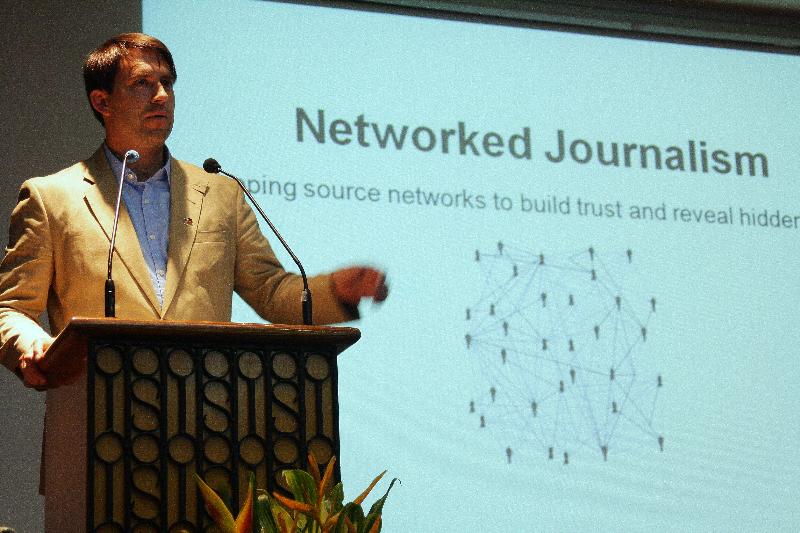
The emergence of Networked Journalism, a communication approach that deals with the integration of public opinion in traditional reporting, was explained by Public Insight Network (PIN) co-founder Andrew
Haeg. PIN is an online network composed of citizens acting as sources of information to professional journalists. Haeg discussed Networked Journalism as an online initiative that systematically integrates the knowledge and insights of the public into daily journalism.
“Today, more than 100,000 people are part of the PIN and every day they inform stories and programs across the American Public Media and at 45 partner newsrooms throughout the country,” he said.
According to Haeg, the PIN can be a tool to reveal hidden truths in the society.
Obesity, recession, agriculture, and war are some of the issues in the United States that concerned the organization. Gathering information and reactions from the public helped them reveal the hidden story behind a particular situation.
“A story can be small, but it can be a big impact if there are 1,000 stories alike,” he said.
“It gives the people a chance to share their story, or to be listened to and an opportunity to get the word out,” Haeg added.
The PIN is encouraging the public to be part of their team in giving credible information that will be shared with various media entities.
“Network Journalism is about tapping sources or networks in order to build trust and to reveal hidden truths that will help you understand and think differently about journalism,” he said. F
The emergence of Networked Journalism, a communication approach that deals with the integration of public opinion in traditional reporting, was explained by Public Insight Network (PIN) co-founder Andrew
Haeg. PIN is an online network composed of citizens acting as sources of information to professional journalists. Haeg discussed Networked Journalism as an online initiative that systematically integrates the knowledge and insights of the public into daily journalism.
“Today, more than 100,000 people are part of the PIN and every day they inform stories and programs across the American Public Media and at 45 partner newsrooms throughout the country,” he said.
According to Haeg, the PIN can be a tool to reveal hidden truths in the society.
Obesity, recession, agriculture, and war are some of the issues in the United States that concerned the organization. Gathering information and reactions from the public helped them reveal the hidden story behind a particular situation.
“A story can be small, but it can be a big impact if there are 1,000 stories alike,” he said.
“It gives the people a chance to share their story, or to be listened to and an opportunity to get the word out,” Haeg added.
The PIN is encouraging the public to be part of their team in giving credible information that will be shared with various media entities.
“Network Journalism is about tapping sources or networks in order to build trust and to reveal hidden truths that will help you understand and think differently about journalism,” he said. F


Year 47 | Issue 3 | 2011
- Home
- Scenes
- Issues
- Perspectives
- Faces
- Letters
- Editorial Staff